AI DJ — Generative Audio-Visuals
Synthra
An AI-powered platform where you speak your mood and a personal DJ generates the track — paired with real-time procedural visualizations for a fully immersive audio-visual experience.
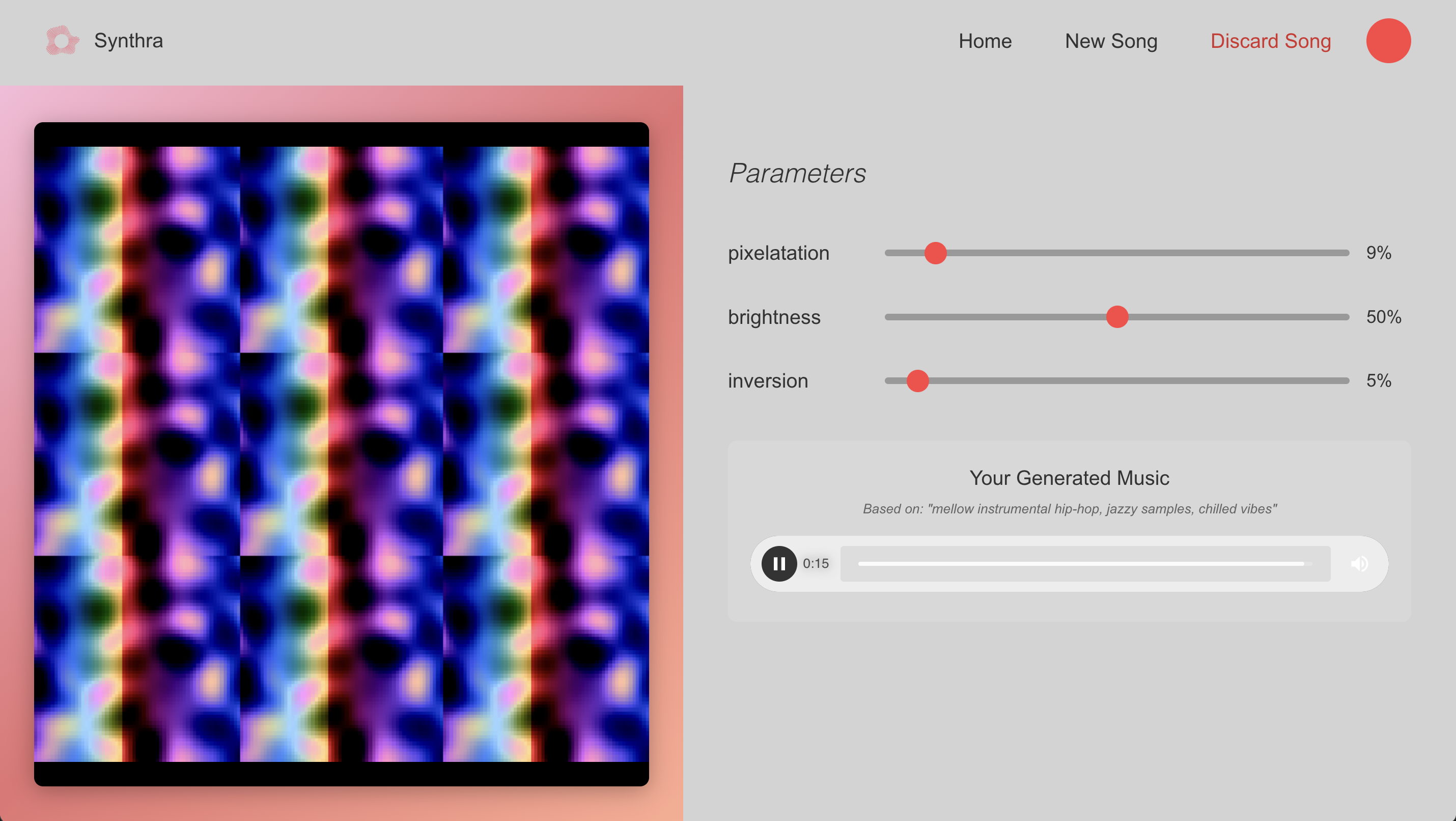
Art and music aren't always accessible — there are unspoken rules, social barriers, and the quiet pressure of needing to "know what you're doing." Synthra was built to remove all of that. Speak your mood, describe a vibe, say almost anything — and Synthra's AI DJ turns it into a track made just for you.
Built at HackMIT, Synthra is a full-stack web platform that uses Suno's API to generate original music from a spoken or typed prompt, then analyzes the resulting audio to drive a real-time procedural visualization using Hydra's video synthesizer. The result is a unique audio-visual identity for every generation — something you made, even if you've never made music before.
How It Works
The experience begins with your voice. OpenAI's speech-to-text converts your prompt into a natural language description, which is passed to Suno's API to generate a full AI-composed track. Simultaneously, the audio is analyzed and its features are mapped to Hydra's visualization parameters — producing an animation that evolves with the song's texture, rhythm, and energy.
The visualizations are procedurally generated using formal grammar systems, meaning each one follows structural rules but never repeats the same output. The visual language grows organically from the music itself, not from a fixed template.
My Contribution
I led frontend design and was responsible for the overall visual language of the platform — including the logo, layout, typography, and aesthetic direction. My goal was to make the interface feel like a creative space rather than a tool: low-pressure, visually alive, and inviting to people who don't see themselves as artists.
Working alongside teammates handling backend infrastructure, the Suno integration, and the AI DJ speech pipeline, I focused on ensuring the visual output felt cohesive and considered — that the look of Synthra matched the freedom it was trying to offer.