IoT & AI — Wearable Hardware
Curiosity Agent
A clip-worn camera and AI system that asks you questions about the world you're moving through — rather than answering them. Designed to support curiosity, not replace it.
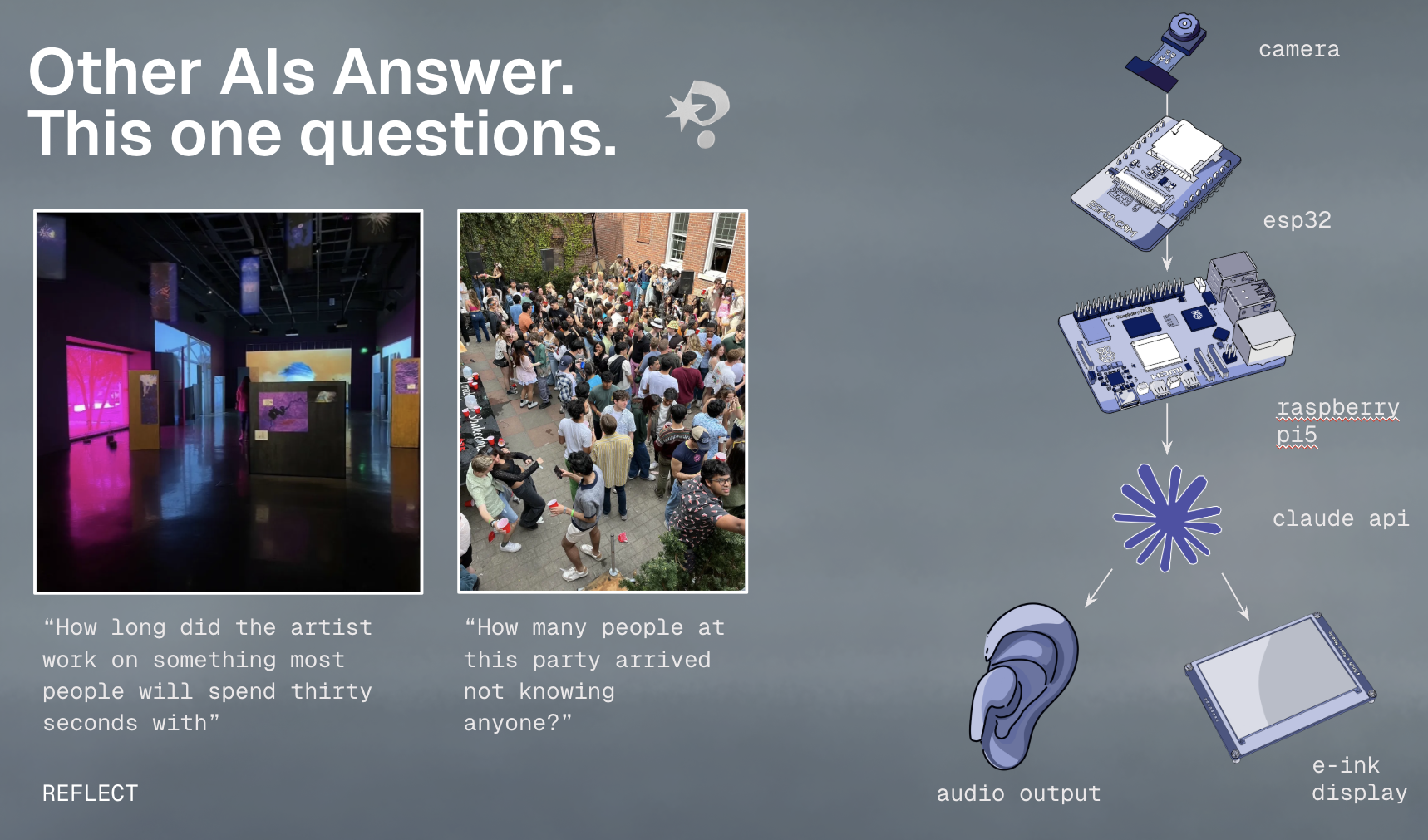
Most AI tools are built around a single premise: you have a question, it has an answer. Curiosity Agent inverts that entirely. Instead of offloading thinking to a machine, it asks you to do more of it — gently, through questions surfaced as you move through the world.
The project started from a concern about cognitive offload: the quiet habit of letting AI do our reasoning for us. We wanted to design an agent that actively supports human flourishing — not by providing answers, but by nurturing the instinct to question.
The Device
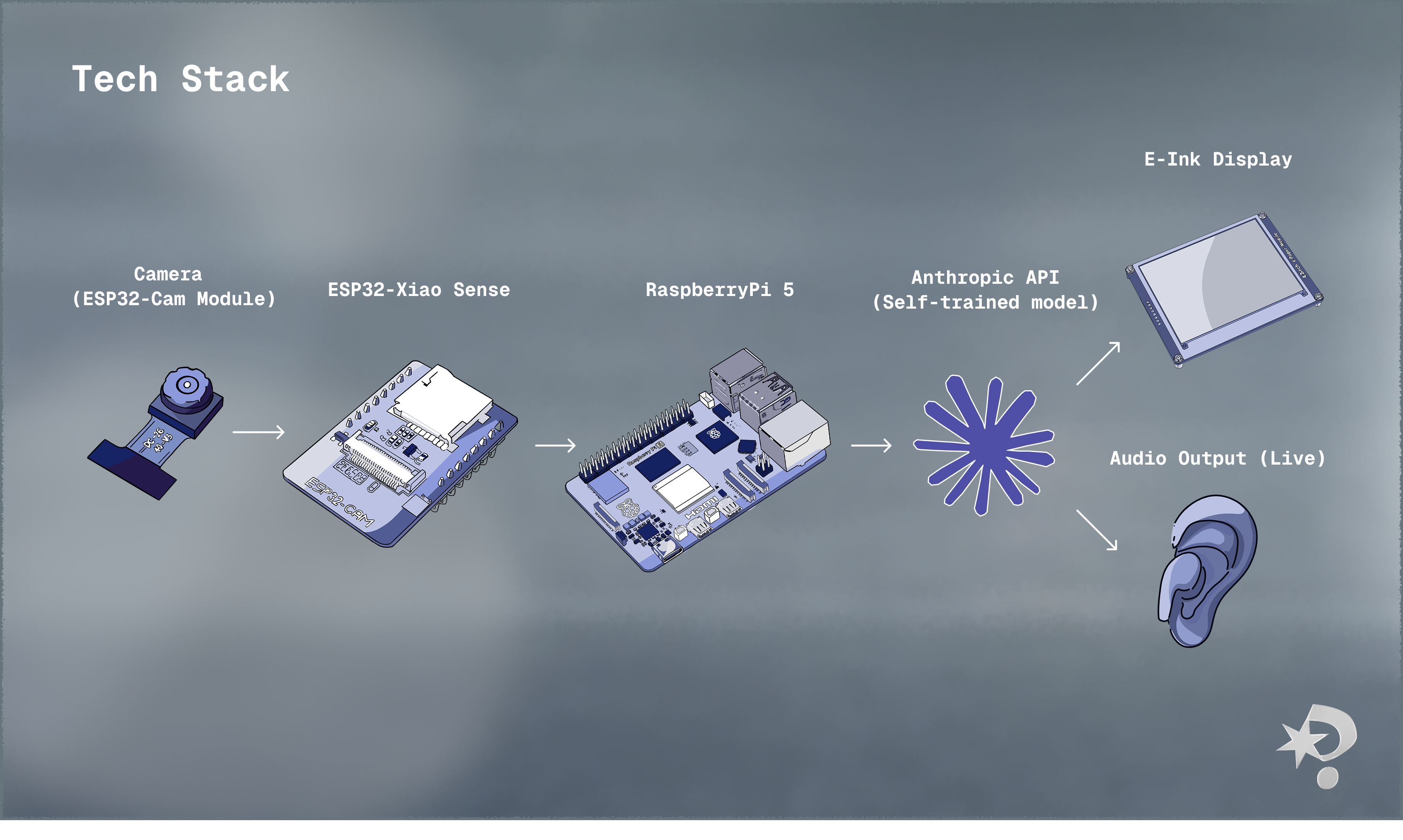
At its core, the hardware is an AI-Thinker ESP32-CAM clipped to clothing, sending real-time images over the local network to a Raspberry Pi base station. The Pi passes those images to Claude through a carefully crafted prompt, and the response — a single question — is delivered through the user's own earbuds. No screen, no app to manage, nothing to interrupt the moment.
Questions are drawn from one of six registers: Observational, Social, Intentional, Prior Life, Predictive, and Absence. The model selects the register based on what the scene calls for — a quiet street gets a different kind of question than a crowded market.
The Dashboard & E-Ink Display
When you get home, the experience shifts. A dashboard surfaces the day's curiosities: the questions asked, the places that generated them, and synthesized themes across the registers. The display hardware was a deliberate design choice — e-ink is slow, persistent, and doesn't pulse or refresh. It shows a record of what kept catching your attention, not a feed demanding more of it.
The Pi and e-ink display were fitted inside a custom 3D-printed dock, designed as a physical ritual object: something you place the camera into when you return, and pick up again when you leave.
Prompt Engineering & the Six Registers
Getting questions that were genuinely meaningful — not generic, not trivial — required significant work on the prompt architecture. A poorly tuned prompt produces questions that feel like a quiz. The goal was to produce questions that feel like they came from a thoughtful companion who noticed something you almost walked past.
Each of the six registers required its own framing logic, and the model needed enough scene context to choose the right one. Image quality and framing proved as important as the language of the prompt itself.